
To Tell the Story, Write in Scenes: Reduce the Narrative; Show, Don’t Tell
Posted on 10. Mar, 2026 by Paul Sochaczewski in Books, Share Your Journey

Happy International Writers’ Day — March 3
GENEVA, Switzerland

Build a monument, one block (scene) at a time.
Your family has been bugging you to write the story of how you quit medical school (breaking your mother’s heart) and found enlightenment in a Himalayan ashram. Or the story of how you became the world’s first topless rodeo clown (it was the sixties!). Perhaps you have an inner drive to tell folks about your trek in the Andes, where you met the love of your life, or the time you contracted typhoid and were saved by a shaman in Vietnam.
Your quest might be big and life-changing, or small and silly. Doesn’t matter. It’s your journey, and only you can tell it.
But where and how to begin? People say, “write a book.” That’s a big ask if you’re not a comfortable writer. Too big, too . . . intimidating. The trick is to start by writing a single scene.
The scene is the building block of a story.
Here’s one tip (out of 10), gleaned from my book Share Your Journey.
You have one job: Tell the story. And one way to do that is: Write in scenes.
What’s the most memorable scene in literature? For my money, it’s when Little Red Riding Hood goes to her grandmother’s house and sees that granny is looking, well, odd. You know the scene; no doubt it’s a childhood favorite in your home, as it was in mine. “What big eyes you have, Granny!” And so on.
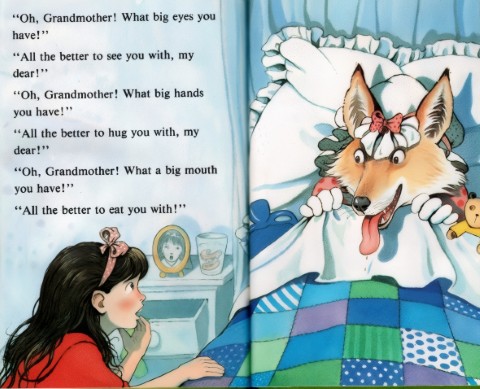 Little Red Riding Hood. Retold by Vera Southgate. Well-Loved Tales. Ladybird Books
 The most perfect scene in literature.
This is a perfect scene. It’s only 150 words, but it contains the five crucial elements that make a scene effective:
- Characters
- Setting (in this case, the scene takes place at Grandma’s house)
- Dialogue
- Conflict/problem
- Movement (often overlooked, this refers to the idea that this scene ends on what I call a Scheherazade Scenario. You might know it as a cliffhanger. There is no immediate closure. Call it literati interruptus. The scene is so compelling that the reader is forced to turn the page and find out what happens next. That’s your only job as a storyteller — get the reader to turn the page.
Effective storytelling relies on minimizing the narrative information dump and instead gifting the reader with scenes, just as you would if you were making a movie. In other words, show, don’t tell.
My book Share Your Journey contains examples of several excellent scenes and a section on how to turn a cold narrative of facts into a vibrant scene.
Here’s an article that is informative but feels flat because the writer has not written in scenes.
Rene Sepul’s lead is as cold as a Wikipedia entry and does nothing to get us into the story:
Luang Prabang, the former royal capital of Laos, is situated by the Mekong River in the mountainous north of the country. It is easy to understand why this peaceful city of exquisite charm and beauty was appointed “the best preserved city of Indochina” and an official “Heritage of Culture” by UNESCO last year. Its origins go back to very ancient times.
Sepul then tells us about interesting events and observations but does not show us. He needs to write in scenes, speak with Laotians, and give us action, not just information. He introduces important and interesting concepts, like “nirvana” and “stupa,” without explaining their meanings. His story has no conflicts, no human beings, and no blood and guts. The result is flat, like this passage he wrote:
The following morning, there is a market where parents go with their children to buy all sorts of animals — small birds, parrots, turtles, lizards and a multitude of fish — and set them free.
The parents believe that by doing this good deed, their children can attain nirvana. Another important item that is for sale at the market is the zodiac flag. The flags come in use later in the afternoon when most people catch a boat to an island on the Mekong where they build sand stupas on the beach.
This is an act of personal purification since each grain of sand that is incorporated in the stupa signifies a sin that one is getting rid of.
(Rene Sepul. “Pi May in Luang Prabang.” Silkwinds magazine.)
Every writer will have their own way of creating a scene out of such a passage. Here’s one way Sepul could have revised this piece and crafted a scene to increase reader intimacy. I’ve made up details, but you get the idea:
One hardly needs to “escape” from Luang Prabang, but I nevertheless sought a respite from the town’s charm. I paid twenty cents one afternoon to board a simple, barely sea-worthy large wooden rowboat (grandly termed a “ferry”) to join several family groups, carrying picnic baskets and child-sized pails and shovels, heading for Paradise Island. Scattered along the beach, on an “island” that was not much more than a large sandbar in the middle of the Mekong, were groups of people building what looked like mound-shaped sandcastles. I looked closer and saw that the constructions were actually sand stupas. When one of these knee-high structures was completed, the architects-of-the-divine made a small offering and placed a market-bought zodiac flag alongside.
Seeing my interest, and perhaps sensing my confusion, an elderly gentleman approached me and asked, in serviceable French, if he could be of service. In my bad French, I asked what was going on. “They are getting rid of their sins,” he said in English but using the French word péchés.” I must have looked bewildered, and he continued. “The stupa represents a holy place that contains relics of Lord Buddha. Each grain of sand signifies a sin that the person wants to get rid of. When the tide comes in, the sins disappear.” My immediate thought was that, judging from the size of these constructions, these folks must have a lot of sins for which they wish to atone, but for once I kept my peace and strolled with the old man along the shore.
Share Your Journey contains several powerful scenes, mostly from writers with whom you are probably not familiar.
But here’s one memorable scene from one of our greatest writers, John Updike. It’s about the last at-bat of Ted Williams, one of baseball’s greatest players.
Fisher, after his unsettling wait, was wide with the first pitch. He put the second one over, and [Ted] Williams swung mightily and missed. The crowd grunted, seeing that classic swing, so long and smooth and quick, exposed, naked in its failure. Fisher threw the third time, Williams swung again, and there it was. The ball climbed on a diagonal line into the vast volume of air over center field. From my angle, behind third base, the ball seemed less an object in flight than the tip of a towering motionless construct, like the Eiffel Tower or the Tappan Zee Bridge. It was in the books while it was still in the sky. Brandt ran back to the deepest corner of the outfield grass, the ball descended beyond his reach and struck in the crotch where the bullpen met the wall, bounced chunkily, and, as far as I could see, vanished.
Like a feather caught in a vortex, Williams ran around the square of bases at the center of our beseeching screaming. He ran as he always ran out home runs — hurriedly, unsmiling, head down, as if our praise were a storm of rain to get out of. He didn’t tip his cap. Though we thumped, wept, and chanted “We want Ted” for minutes after he hid in the dugout, he did not come back. Our noise for some seconds passed beyond excitement into a kind of immense open anguish, a wailing, a cry to be saved. But immortality is nontransferable. The papers said the other players, and even the umpires on the field, begged him to come out and acknowledge us in some way, but he never had and did not now. Gods do not answer letters.
(John Updike. “Hub fans Bid Kid Adieu.” New Yorker. October 22, 1960.)
In my book Share Your Journey: Mastering the Art of Personal Writing, you’ll learn how to:
- Recognize the dynamics of your own hero’s journey.
- Get started by writing just one scene.
- Avoid the dreaded “info dump.”
- Create instant intimacy with the reader.
- Tell the story by following the Little Red Riding Hood Strategy.
- Create conflict with the Nancy Reagan Principle.
- Keep ’em hanging on with the Scheherazade Scenario.
- Invoke the Story of One to represent the Story of Many.
- Write like Steven Spielberg directs.
- Eliminate fluff like Michelangelo.
 SHARE YOUR JOURNEY: Mastering Personal Writing
Explorer’s Eye Press. Geneva, 2016.
ISBN: 978-2-940573-17-2

