
Return to Island of the “Lost Indonesia Jews”
Posted on 21. Jan, 2026 by Paul Sochaczewski in Curious Travel
Return to Island of the “Lost Indonesia Jews”
Seven Years Later, the Mystery Remains Unsolved
 Paul Spencer Sochaczewski
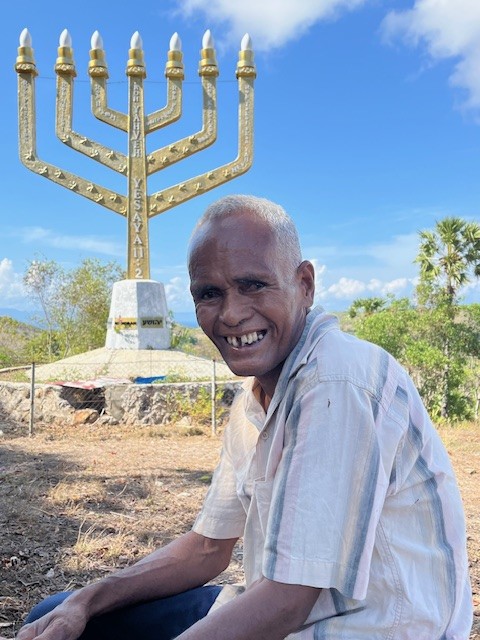
 Paulus Mauky, seated with a giant menorah that was gifted to his family by Ibu Ondang. A plaque on the menorah references Isaiah 11.2 (The Spirit of the Lord will rest on him — the Spirit of wisdom and of understanding, the Spirit of counsel and of might, the Spirit of the knowledge and fear of the Lord.)
Happy World Religion Day — January 18
KISAR ISLAND, Maluku, Indonesia
In 2018 I traveled to the tiny and isolated Kisar Island to try to solve a mystery. Like most of my quests, the trigger came from an unlikely source, a mere wisp of a one-paragraph mention in a book by a respected British journalist. I wrote about that journey in this article: “Lost” Indonesian Jews Recruited to Fulfil Biblical Prophecy.
But I didn’t get the full story, and questions remained about why these small-holding farmers were thought to be Jewish and how they had been promoted from obscurity by an evangelical missionary who used them as catalysts to facilitate the Second Coming of Jesus.
I returned to Kisar in October 2025 in an attempt to close the circle. Here’s the story, which I suggest you read as a follow-up to the earlier article referenced above.
* * *
Sherlock Holmes probably could have solved the mystery if he hadn’t been high on his “seven-percent solution” of cocaine. Hercule Poirot also might have been capable of unraveling the tenuous threads of my riddle, but the case lacked the upper-class allure he preferred. And C. Auguste Dupin would have refused to consider the case outright, since it involved neither blood, nor gore, nor angry spirits.
What the mystery did offer, though, were curious conundrums. What was a small clan of Jews doing on a tiny, remote island in eastern Indonesia? Were they, in fact, Jewish at all? And why were four of them whisked off to Israel by a wealthy Indonesian evangelical Christian on a religious rescue mission to which she has devoted her life?
* * *
I didn’t have Miss Marple on the case, but I have friends who offered advice, support, and a multitude of theories: Professors at Pattimura University, the largest in the region. Members of the Kisar royal family. Local people with various degrees of insight and information. My guide, Mercy Francis, and driver, Ulis Jonas. And, of course, the dozen or so Jews themselves who live on the dry island, accessible by slow boat or more-or-less scheduled flights on 10-seat airplanes. All were generous in trying to complete the circle. Theories flew. Too many to solve the riddle.
* * *
To give you an idea of the multiple speculations I heard, here are some highlights of diverse (nonproven) explanations of why Paulus Mauky, the patriarch of the Kisar Jewish clan, and his family are indeed Jewish:
Ancestor Tribes
- They are descendants of Gad, one of the 10 Lost Tribes of Israel.
- No, they are of the Tribe of Levi, one of the recognized 12 Tribes of Israel.
European Sailors or Soldiers
- Kisar has a large Indo-Eurasian community, where some people have Dutch features and blue eyes. But one woman in that community said that she had never heard of any family connection with the Jewish clan.
- They are descended from one or more (Jewish) Dutch soldiers shipwrecked on the island in the 16th century. (Kisar was a trading hub; one person suggested as evidence that Kisar sheep have similar DNA to African/Arab varieties.)
- They are descended from sailors on Magellan’s 16th-century expedition (which we know stopped in Tidore, an island in the northern part of the Maluku province. But it’s quite a distance — Kisar is at the far southern end of the province, some 2,000 kilometers (1,200 miles) due south of Tidore. Tidore, along with neighboring Ternate, was where cloves originated — one of the spices that spurred Magellan’s fleet to explore these distant lands.
Inter-Island Migration
- They are descendants of a 13th-century migration of Jews from Seram Island.
- They are descendants of a 15th-century Jewish religious figure from Yemen (the Hadramut family clan).
- They are descendants of Jews coming from nearby Timor island some 700 years ago — specifically the three descendant families: Wedilen, Tamindael, and Mauky (Paulus Mauky’s family name).
Ethnic Slur
- People without formal religion (non-Christians, atheists) were called Yahudi (Jewish) in this predominantly Christian island.
Mystery box
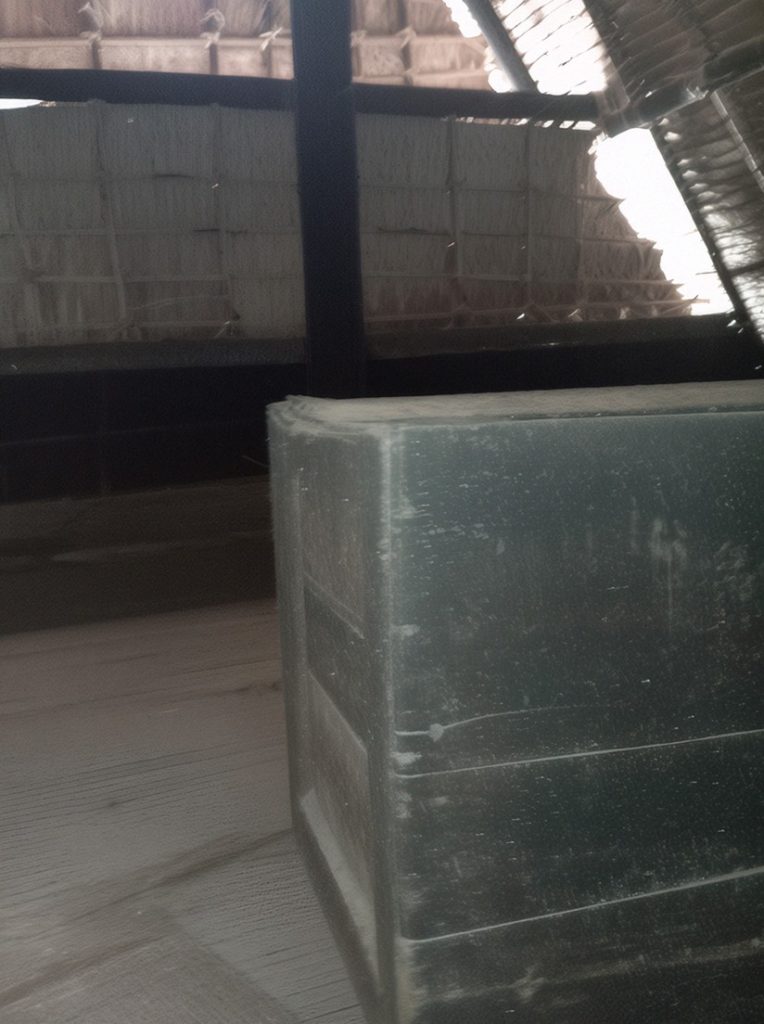
- And, perhaps the most tantalizing (and thoroughly enigmatic) clue was discovered by my guide Mercy Francis several weeks after I had left Kisar. She wrote that she visited the family home of Agus Mauky (the brother of Hermanus Mauky, the prominent “Jew of Kisar”). Agus’s son showed Mercy a large wooden box (see photo) that had been in the family for decades. He said his father told him the box contained sacred objects and that he should never open it.
 Mercy Francis
 The Mystery Box that belongs to the family of Agus Mauky on Kisar Island. The family was told never to show it to outsiders, since it contains very sacred objects.
* * *
I hoped that Paulus Mauky might provide some hard evidence.
When I arrived at his simple home in Oirata village, he was sitting on the porch, playing with his granddaughter Elizheva.
He greeted me like a brother: “Yahweh protects both of us so we could meet again.”
Paulus, 55, is a gentle man, and I feel he sometimes is overwhelmed by the attention he gets. He said he was pleased to meet me again. I gave him some printed photos from my visit seven years earlier and some gifts from Switzerland.
I felt awkward asking how he knew he was Jewish. When I had met him in 2018 he seemed uncertain, as if for his whole life he had been told he was Jewish and never questioned it. But he had little knowledge of Jewish customs, history, or rituals. What awareness he did have had been imposed on him — first when Rumondang M. Sitompul, who is generally referred to as Ibu (Mother/Madam) Ondang, whisked him and three other Jewish men from his village clan to Israel. Following this adventure, she began turning his simple family compound into a showpiece for Jewish architecture, symbolism, and bling. The latest innovation since my first visit was the installation of a five-meter-tall menorah near the thatched-roof building grandly called a synagogue. Ibu Ondang had mentioned this menorah when I met her in 2018 and complained it was stuck in a shipping office in Surabaya. Obviously she had obtained the sculpture’s release, and it is an unmissable symbol that by its presence shouts: “Here be Jews.”

 Paul Spencer Sochaczewski
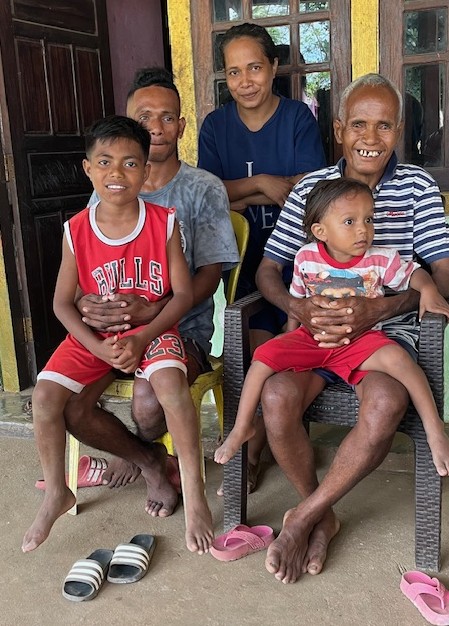
 Top: The synagogue on Kisar island, with a prominent menorah, a Judaic candelabrum symbolizing God’s light. Bottom: Paulus Mauky and family.
I pursued the question. How does Paulus know he’s Jewish? He explained that when he was a boy, his father had a well-guarded box containing a stick of unknown utility, a piece of cloth with a picture of the Lion of Judah imprinted on it, and a small stone sculpture representing the 12 Tribes of Israel. But Paulus wasn’t allowed to play with or even touch these heirlooms. Moreover, his memory is foggy, and their current location is unknown.
Any other “proof?”
Proof, when applied to religion, often comes in the form of miracles. Paulus recounted several incidents that occurred in 2011 when he, his uncle Hermanus Mauky, and relatives Yohanis Tahinlaru and Jeriy Mauky made the long journey to Israel with Ibu Ondang, flying (for the first time) to the provincial capital of Ambon, then on to Jakarta, then Jordan, and overland to Israel.
- The ground shook when Hermanus crossed the border from Jordan into Israel.
- A rabbi greeted him and declared, “A son of Israel has returned.”
- Ibu Ondang had a technician take Hermanus’ blood and sputum samples; the resulting DNA test proved he was Jewish.
- The group visited the tomb of Abraham in Hebron. Ibu Ondang asked him to identify the nearby grave of Abraham’s wife, Sarah, which he did without prompting. He went to Sarah’s grave and started praying in Old Hebrew, a language he had never heard before.
- The same day, the sun was high overhead, and the temperature was sweltering. But a dark cloud appeared over Hermanus, and cooling rain poured down on his head, and only on him, not on anyone else.
Combine these incidents with the story Ibu Ondang tells about how she saw a ball of flaming light while flying over Kisar and “knew” there were Jews on the island. (Full story in “Lost” Indonesian Jews Recruited to Fulfil Biblical Prophecy.)
Do these tales constitute “proof?” It is for Paulus, and it is for Ibu Ondang, and that’s all that matters.
 Paul Spencer Sochaczewski
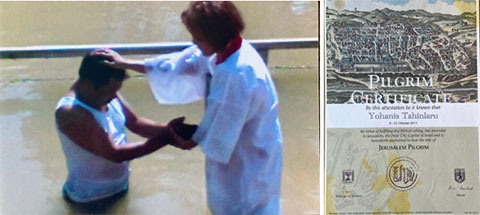
 Yohanis Tahinlaru was the motorcycle driver who had serendipitously met journalist Elizabeth Pisani when she arrived in Kisar for a single afternoon. He had asked her: “Do you want to meet the Jew?” One easily overlooked paragraph about this encounter in her book triggered my desire to visit Kisar. Yohanis was one of the four ostensibly Jewish men who were taken to Israel in 2011 by Ibu Ondang. These photos show his baptism, his Pilgrim Certificate, and his Christian tomb and gravestone in Kisar
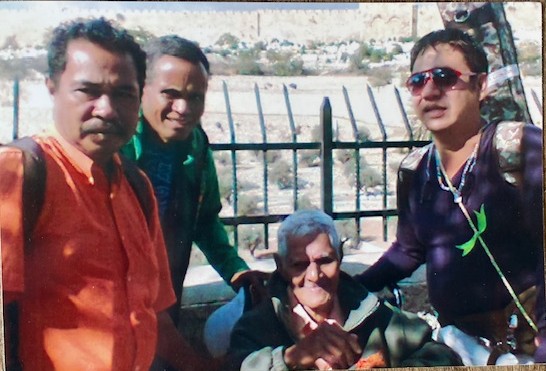
The four men from Kisar brought to Israel in 2011 by Ibu Ondang. Paulus is second from left; Hermanus is seated.
Psychologists have several terms for the power of such deeply ingrained beliefs — the illusory truth effect, the repetition truth effect, repetition bias, and confirmation bias. They differ slightly but basically have the same result: embedment. The more you repeat something, and the more other people repeat the same idea, the stronger it becomes in your mind until it is an unshakeable belief. When an idea without foundation is repeated often enough, that idea (think “the American election was stolen,” or “vaccines are dangerous,” or “the moon landing was a hoax”) becomes impossible to dislodge with logic or science. In many religions, the repetition truth effect is an essential element in convincing a person that his religion is the “true” religion, the tales told in a particular holy book are literally true, and other faiths are “false.” In Paulus’ case, he has internalized the idea that he is Jewish; it has become an essential part of his persona.
* * *
Yet there are contradictions. It comes down to whether there is such a thing as a “pure” religion, one “correct” way of praying, behaving, and proselytizing. In the case of the Jews of Kisar, there is considerable overlap with Christian rituals. For example, Hermanus, Paulus, Yohanis Tahinlaru, and Jeriy Mauky were baptized while in Israel. It feels like they have been manipulated.
And then there is the story of Herfiles.
 Paul Spencer Sochaczewski
 Herfiles Mauky’s graduation photos from the Pusat Seminari Bukit Gibeon.
When I revisited Kisar, the big news in the family was that Paulus’ son Herfiles, 25, had returned in 2023 from a three-year diploma course at Pusat Seminari Bukit Gibeon (Gibeon Hill Seminary Center), near Lake Toba, north Sumatra, about as far from Kisar as one can go while staying within Indonesian territory. The campus is modern, spacious, green, and well-maintained, with strict rules about how the neat and squeaky-clean students and sightseeing visitors must dress and behave. Its main aim is to train evangelical Christian pastors, but the students are also taught animal husbandry, horticulture, fishing, cooking, and home economics. Judging by the Instagram photos and reports it’s as neat and rigorous as any college in the country, with crystal chandeliers, bling-infused prayer rooms, and architecture that incorporates both the Christian cross and the Jewish menorah.
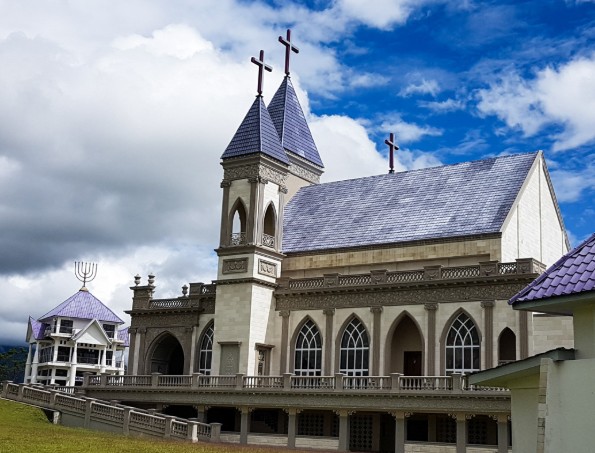 DailyVoyagers.com
 Tower of Prayer (background, with menorah) and House of Prayer for All Nations at the Pusat Seminari Bukit Gibeon.
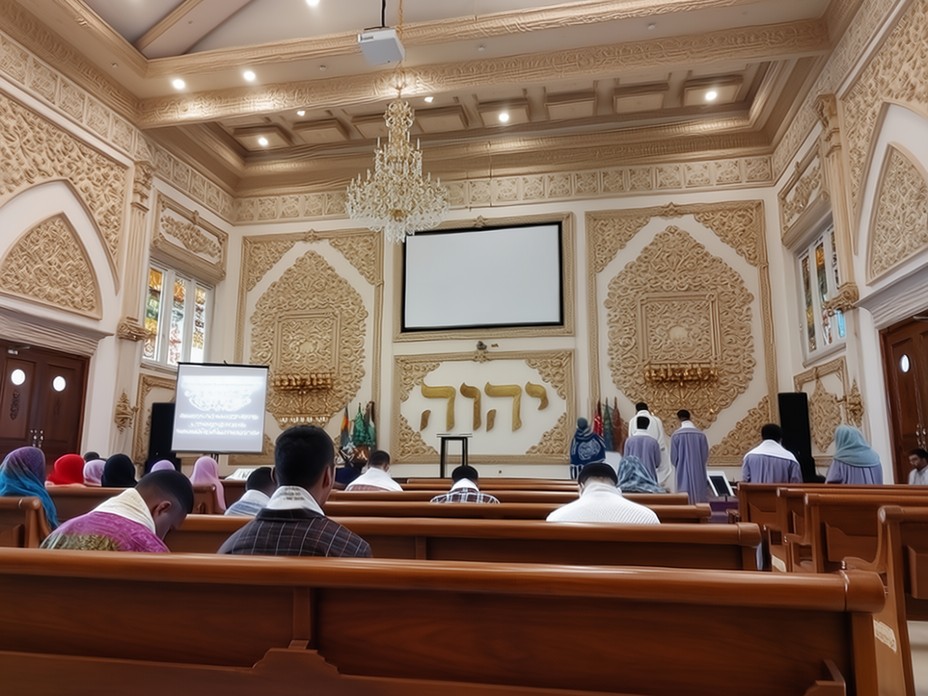
The Hebrew term for Yahweh (God) is featured inside the ornate (note the crystal chandelier) Tower of Prayer (note the crystal chandelier).
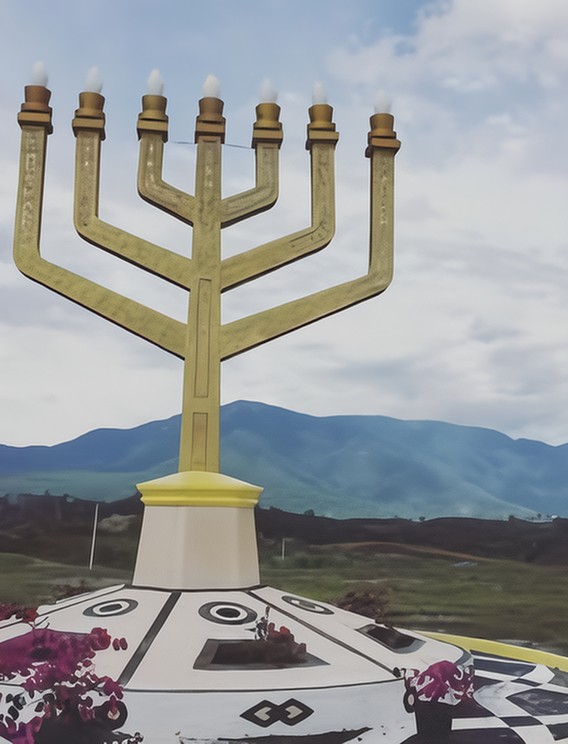
Menorah at Pusat Seminari Bukit Gibeon in Sumatra, Indonesia. Note the similarity to the giant menorah donated to the Jewish community of Kisar island by Rumondang M. Sitompul (Ibu Ondang).

The seminary — modern, neat, clean, and successful at training young evangelical pastors.
Herfiles identifies as a Messianic Jew, a relatively modern term for a Jew who considers himself ethnically and culturally as Jewish but believes Jesus (Yeshua) is the promised Messiah.
Messianic Jews often worship in synagogues, observe the Jewish Shabbat, and practice some Jewish cultural patterns and rituals, but they also accept the New Testament and believe that Jesus was the Messiah and a divine being in the form of God the Son. Messianic Judaism is generally considered a Christian sect. (Paulus prefers the term “Modern” or “New Judaism.”)
This combination of Jewish and Christian elements was evident in a small midweek service I attended in Kisar’s synagogue.
The short service was a hybrid of Jewish elements (blowing of the shofar, some readings from the Old Testament) with several clearly Christian rituals — communion wine and communion wafers printed with New Testament quotations.

 Paul Spencer Sochaczewski
 Herfiles, wearing a tallit, leads an informal Jewish prayer service in Kisar that includes the blowing of the shofar, communion wafers imprinted with biblical quotations, and communion wine.
* * *
And the motivation of Ibu Ondang? She is an evangelical Christian. When I met her in 2018 at an upscale coffee shop in a Jakarta shopping mall she proudly told me that she had been to some 80 countries to encourage Jews to return to Israel. I contacted her via WhatsApp Messaging during my follow-up trip to Kisar in October 2025, hoping she could clarify why she believed that Paulus’s family were Jewish, her motivations for bringing them to Israel, and why she gifted the tiny community with a synagogue and a giant menorah. She said she was busy and agreed I could send her some questions in writing. After about a month of silence, I contacted her again. She was busy, in Azerbaijan, she said, likely continuing her goal of bringing all the “lost Jews” of the world to Israel to facilitate the Second Coming. As of early January 2026, I have not received any word from her with answers to my questions about her motivations.
Nevertheless, her motivation seems clear. The Bible contains numerous prophecies linking the return of Jewish people to Israel with End Times events that precipitate Jesus’ Second Coming. As I understand the religio-geopolitical interpretation, some Christians encourage a moment when Israel as a nation recognizes Jesus as the Messiah, leading to a universal knowledge of God and world peace. I can speculate that this type of Biblical prophecy would encourage Ibu Ondang to engage in her missionary work with a God-driven vigor.
* * *
Indonesia has no state religion, and the Indonesian constitution guarantees freedom of religion. More to the point, everyone has to declare a religion to get a government identity card. There are six “official” religions on offer — Islam, Protestantism, Catholicism, Hinduism, Buddhism, and Confucianism. In 2017 the government added Aliran Kepercayaan (“streams of belief”) as an option. This is an umbrella term for various forms of mystical, traditional, and Indigenous beliefs. It is not considered a formal religion but is classified separately as a “belief” or “culture.”
The official list of religions does not include Judaism. Paulus Mauky’s identity card lists his religion as Protestant, as does the identity card of his son Herfiles. The grave of Yohanis Tahinlaru, one of the four men whom Ibu Ondang took to Israel, features a Christian cross, and the grave of the patriarch, Hermanus Mauky, also features a cross but with a reference to an Old Testament verse. In 2025 Hermanus’s Jewish son, Octavianus Mauky, went on a Christian pilgrimage to Israel; he now identifies as a Charismatic Christian. For an outsider used to a black-and-white view of the world, this might seem like an uncomfortable mash-up of religions. But throughout the world, religions mix together, overlap, enrich each other, and create something new. In any case, what’s in a name? It works, and sometimes an insistence on religious “purity” can be unproductive.
Nevertheless, purists might question Paulus’ claim to be Jewish based on two commonly accepted defining principles. A Jew is a person who has either converted to Judaism through a formal study of Jewish scripture and beliefs, and has undergone a traditional conversion ritual (the hard way), or someone whose mother is Jewish (significantly easier). Paulus and Herfiles do not meet either criteria.
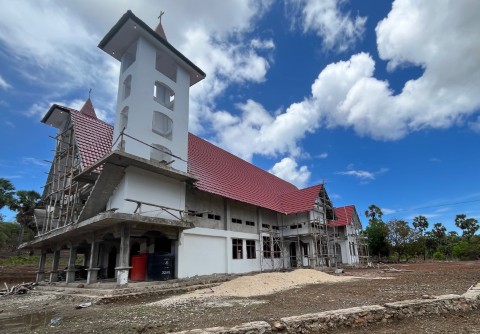
A large church under construction in a rural section of Kisar island. The population of 14,000 is largely Protestant, and every village seems to have its own church, similar to the fact that almost every village in the Muslim-majority region of Indonesia wants its own mosque. These extravagant places of worship, much more elaborate than most homes in rural areas, are a common sight. Obviously such structures cost a considerable amount of money; one wonders who is paying for these buildings.
 Paul Spencer Sochaczewski
 It’s not all religion in Kisar. Secular life on the island emphasizes the realities of modern Indonesia — the need to earn a living, get a job, look after your family. This street sign alerts the infrequent motorists that they are entering a school district. And, no doubt, the creators of the sign hope to inspire students to pay attention in class, so they, too, can grow up to be as clever and accomplished as Einstein.
* * *
A confession: On this last trip, I was a lousy historian, a lazy journalist. On reviewing my notes about the “lost Jews,” I see many contradictory statements, hypotheses, and wild theories that I might have followed up on but didn’t. In my defense, I didn’t see any light at the end of the tunnel, since finding the “truth” in this situation would have been akin to specifying GPS coordinates for Brigadoon. But some things are not meant to be dissected; they are destined to remain ephemeral, impossible-to-measure beliefs that are not subject to the scientific rigor of proof. I seem to be attracted to this type of quest, and often when I reach out to grab the gold ring, it disappears in a puff of fairy dust.
I recall the wisdom of the late Sri Sultan Hamengku Buwono IX of Yogyakarta, Indonesia. The sultan was a well-educated man, a hero of Indonesia’s fight for independence, a vice president of the nation who wielded huge influence on the spiritual beliefs of his subjects. In the 1970s I interviewed him on his relationship with Kanjeng Ratu Kidul, the Queen of the Southern Ocean (whom I had dubbed the Mermaid Queen, to the consternation of some local citizens). The sultan owed his position and immense stature to the support given by Ratu Kidul (literally Queen of the South) to the sultan’s ancestor, Prince Senopati. It’s a complicated story that dates back centuries, but one that retains a strong presence in the hearts of modern citizens of today’s Central Java region. (Ask a modern resident of Yogyakarta or nearby Solo [Surakarta] if she believes in Ratu Kidul, and she is likely to say, “fifty-fifty.”) I asked the sultan, as politely as I could, why a man who had been educated in Holland, who was a former Minister of Economics, Finance, and Industry and Minister of Defense, could respect, some might say worship, such a mythical creation. What he told me resonated with Hamlet’s advice to Horatio (“There are more things in heaven and earth, Horatio, / Than are dreamt of in your philosophy”). He basically said: Part of my brain is, as you pointed out, a logical Western brain. But another part of my brain is Javanese — intuitive and open. You are asking a Western scientific question. That’s the wrong way to consider the situation. Don’t try to dissect it or analyze it. Either believe it, or don’t.
I decided I had done all I could to dissect Paulus Mauky’s belief system.
I left with my own questions. Do I really care that the “lost Jews” of Kisar are Messianic Jews (or Charismatic Christians) who follow a faith with a mixture of evangelical Christian and Jewish tradition? After all, the only constant in life is change. I don’t believe in any formal religion, so I don’t have a dog in this fight. Shouldn’t these folks be allowed to happily mix and match as it suits them? Fashion changes. Food changes. Language changes. Music changes. And, of course, faith changes. You might believe in a Hairy Thunderer or a Cosmic Muffin, a multiarmed omnipresent destroyer or an elephant-headed remover of obstacles. You might believe that the holy spirit is an all-seeing, no-nonsense, don’t-talk-back omnipotence or a kinder you-are-beautiful-just-the-way-you-are spirit that lies within every human being. You might whisper a thank you to the spirit of the trees under a full moon or self-flagellate as penance for your inherent evil. You might think you are a sinner waiting to be saved, or you are a ray of light, put on Earth to inspire others. Pray to whatever spirit you want, just don’t be aggressive toward believers of other faiths. Live and let live. Is Paulus and his family Jewish? Their brand of Jesus-worshipping Messianic Judaism, encouraged by Ibu Ondang, might be difficult for “purist” Jews to accept. But if that’s what they want to call themselves, so be it.
After this trip, I asked myself: Why do I bother? Am I meddling and putting unwanted ideas into the heads of Paulus and family? What business is it of mine whether Paulus and his family are Jewish? Does my quest have any meaning beyond the excuse for an enjoyable trip to an out-of-the-way Indonesian island? Should I instead spend my time trying to decipher bigger questions: What exactly is a Higgs boson? Is there a “genius gene” that pops up once in a while and gives us a Hawking, a Puccini, a da Vinci, or a Shakespeare? Why are white elephants symbols of royal power and legitimacy? Will we ever have proof of a “snowman of the jungle?”
In any case, why should I spend my time trying to define a Jewish genealogy that seems to be fueled by hearsay, justified by foggy oral tradition, attested to by purported miracles, and built on smoke and mirrors?
Plenty of other mysteries to address. It was time to move on.
SIDEBAR I
Another Kisar Mystery — Origin and Meaning of Cave Paintings
Archaeologists have found 13 recorded sites of limestone rock paintings in Kisar.
Why are they considered “mysterious”?
Scientists aren’t certain about the age. One of the best estimates is that they are around 15,000 years old, according to Lucas Wattimena, of the Indonesian National Research and Innovation Agency (BRIN). The 13 Kisar sites were only subject to the first archaeological surveys in 2014 and 2015, and more research is underway.
In an article published in the Journal of Island & Coastal Archaeology, Sue O’Connor and colleagues note that the Here Sorot Entapa rock shelter on Kisar was “first occupied in the terminal Pleistocene by people with advanced maritime technology who made extensive use of local marine resources and engaged in social connections with other islands through an obsidian exchange network.”
In a separate article, O’Connor and colleagues suggest that “painted rock art [in the Austroneasian diaspora] may have been its most potent material expression and constituted a symbolic language linking island communities across this vast maritime region.”
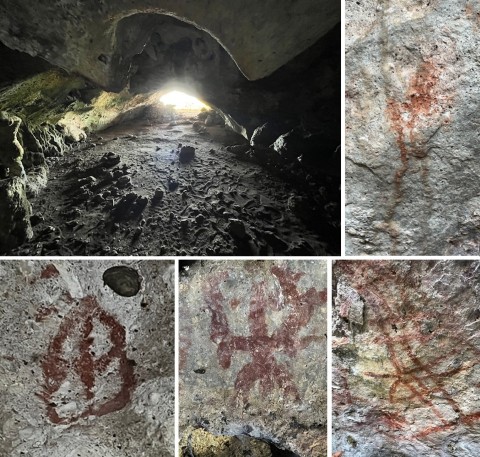
Below, I present photos of some rock paintings from the Wosi Posi site on Kisar Island. One estimate suggests some 3,000 different paintings can be found on the Manhattan-sized island.
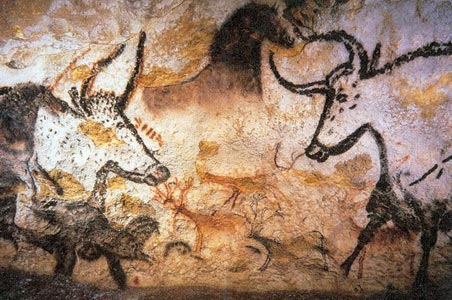
Many of the Kisar paintings are abstract, and their meaning has yet to be decoded. They differ significantly from the rock paintings of Raja Ampat, in the same general geographic area, and are considerably different from the famous figurative paintings of European sites, such as Lascaux (some photos below for comparison).
 Paul Spencer Sochaczewski
 Rock paintings from Kisar island, Indonesia
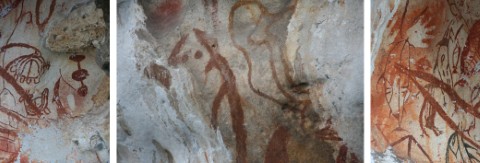
Rock paintings from Raja Ampat, Indonesia
 Wikipedia
 Figurative rock painting from Lascaux, France, usually estimated at 17,000 to 22,000 years
SIDEBAR II
Writing History Is a Slippery Task
When I wrote a speculative biography about Ali, the assistant of Alfred Russel Wallace (see two articles about the challenges of writing history: The Unexpected Perils of Writing an “Enhanced Biography” and “Look Here, Sir, What a Curious Bird”), I realized there is precious little absolute “truth.” While we might have some facts specifying dates of birth, death, marriage, and occupation, these bits of data do not tell us anything about the emotions, the challenges, or the joys of the individual in question. Even autobiographies, one might say especially autobiographies, are misleading. We all misremember (often deliberately). We exaggerate. We edit. We filter. We tell different stories to different people. And, of course, the people who listen to our stories have selective hearing; think of the parlor game Chinese whispers.
Adding to the confusion is the predilection many Indonesians have to believe without question supernatural myths, urban legends, and fantastic stories. Erich von Däniken, author of the fantastical Chariots of the Gods, is widely considered a truth-telling historian. Indonesian social media and video channels abound with tales of the supernatural and alien visitation (which I find refreshing and fascinating from a sociological point of view). However, the need for scientific enquiry and factual analysis is relatively overlooked.
In the case of the Kisar Jews, there are no public records, no written genealogies, no clear oral histories. This lack of proof, of course, is not limited to Kisar. How many of us in fact-obsessed Western culture know much about our ancestors prior to, say, three or four generations previously? I have almost no information about my own mother’s ancestry; she claimed not to know very much, but I kick myself for not forcing her to explain her family’s background and their rationale for moving to the United States in the early 20th century. I would have settled for her speculations. In the end, I’m left with a big hole in my family tree.
I’ll leave the search for evidence of Paulus’ Jewishness to anthropologists with more time, skill, and patience than I have.
This article is expanded from earlier articles published in:

Curious Encounters of the Human Kind — Indonesia
ISBN:
978-2-940573-05-9 Kindle
978-2-940573-03-5 Print on demand
978-2-940573-04-2 Ingram
Available at Amazon or independent booksellers.


Quests: Searching for Heroes, Scoundrels, Star-Gazers, and a Mermaid Queen
ISBN:
978-2-940573-43-1 (Paperback)
978-2-940573-44-8 (ebook)
Available at Amazon or independent booksellers.
The sidebar on the challenges of writing an enhanced biography is excerpted from:

“Look Here, Sir, What a Curious Bird”
ISBN:
978-2-940573-41-7 (Paperback)
978-2-94-573-42-4 (ebook)
Available at Amazon or independent booksellers.